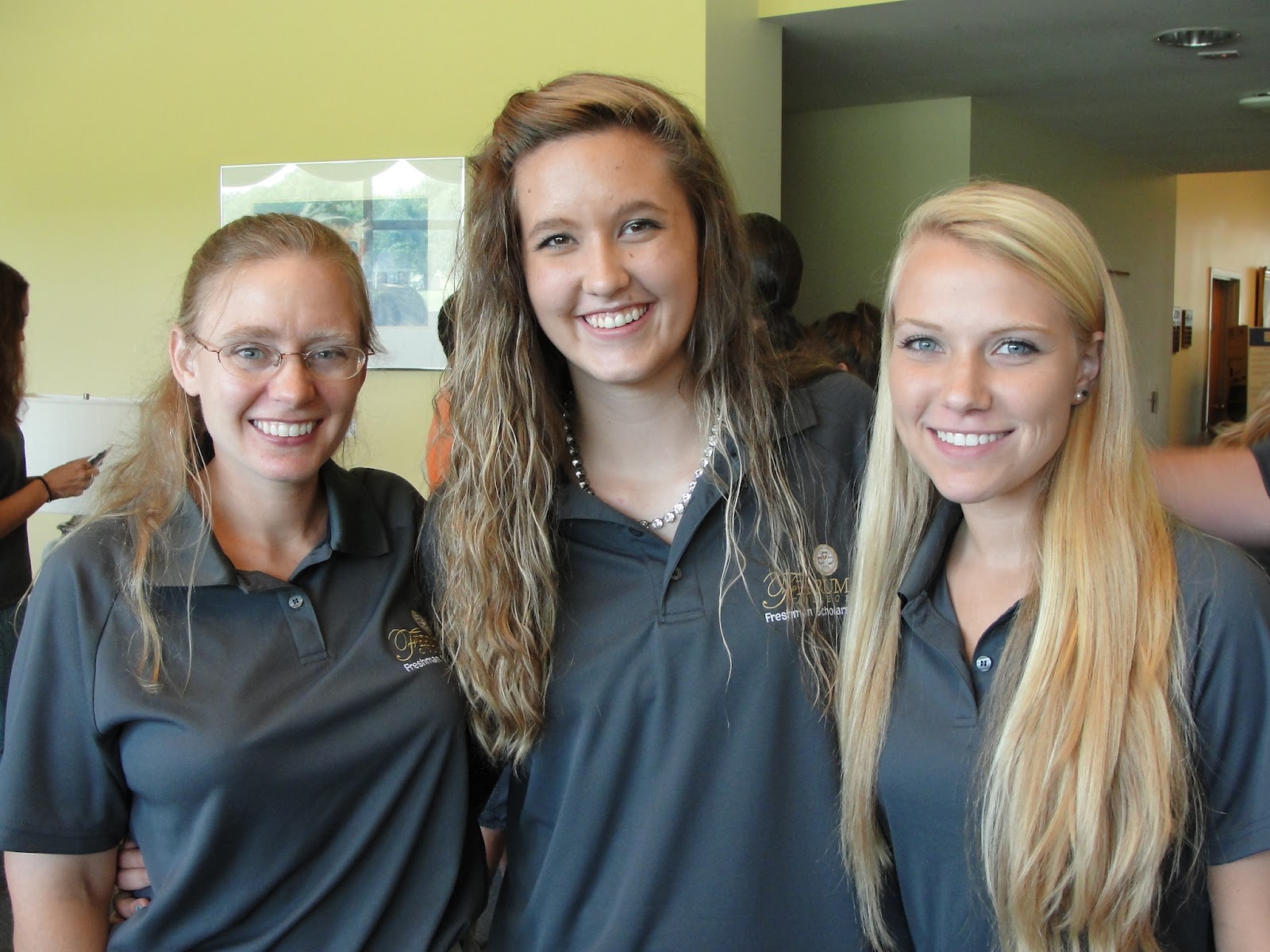
(Caitlyn was one of two students who worked on the Development of an Animal Model for the Cognitive Deficits Observed in Post-Traumatic Stress Disorder (PTSD) project with faculty mentor Dr. Megan St. Peters during the inaugural Freshman Scholars Program in summer 2012.)
by Caitlyn T., Freshman Scholar and Guest Blogger

I stared at the plastic box in Dr. St. Peters' hands as if it was the fourth horseman of the apocalypse, carrying with it my inevitable demise. Red eyes gleamed from behind a helmet of white fur, and a wormy tail thrashed about wildly so that I could barely make out the number written there in black marker. I knew that hidden beneath the small nose and long whiskers, razor sharp teeth were awaiting my unsuspecting fingers.
I am going to die, I thought.
Right here. In this lab.
I heard Dr. St. Peters' voice, but knowing that a thin sheet of plastic was all that separated us, I could hardly focus on anything but the white pile of fur in front of me. Suddenly, its tiny claws made their first appearance, and I quickly averted my gaze. I was just in time to hear my mentor explain to us how to handle the scurrying creatures, and I realized that my time had come.
Why am I doing this? Right. Because I'm an idiot.
At that moment, I wanted to tell my mentor that I had been wrong all along: that I couldn't work with rodents, that I hadn't understood how scary they actually were, and that everything sounded different when she was on the other end of a telephone conversation. But I could tell by the expectant look in her eyes that I wasn't going to be getting out of this. So with a deep breath, I stepped up to the container resting on the smooth black countertop and tried to suppress the urge to run straight out the door and onto the street.

Hesitantly, I stroked the rodent's soft fur, mentally preparing myself for what I would have to do next. Then, before I could talk myself out of it, I latched my fingers onto the base of its tail before lifting it into the air. For a moment, the animal was flailing, its tiny claws slicing the air in every direction. A shrill squeak escaped its fuzzy body as I plopped it onto my outstretched arm and jerked it toward my body while my mind was still screaming to run for my life and never look back.

And then it was in my arms, nestled against my chest. Looking down at the small creature, I began to notice things I hadn't before -- the softness of the hair, the way the nose would twitch periodically, the fluffiness of its ears. Even through the latex gloves, I could feel the fragility of the little rodent I was holding.
And suddenly, I wasn't so scared.
The rat wasn't going to hurt me. He hadn't made a single move to bite me since I first grabbed him by the tail. He had never been a threat. The only part of me that had suffered was my pride. I had just let myself be frightened by something not much larger than the hand that was now holding it. I laughed at myself as I realized that I had just made a new friend -- the red-eyed rat.

 The whole time I was at the Freshman Scholars Program, we did many events that I would have never done at home. When we went to climb the rock wall, I surprised myself by climbing it. I am so afraid of heights, but I still decided to repel off of the rock wall. I was excited as I was climbing up the ladder, but when I got up there, I wanted to turn around. Everyone up there kept encouraging me to just try it, so I did. While I was leaning back about to repel, all I kept saying was "I'm going to die!" Then I let go and started easing my way down. I was so excited at what I had accomplished.