Monday, December 13, 2010


By Lana A. Whited
Professor of English and Director of the Boone Honors Program


In the classroom, I ask a lot of questions to which I already know the answers, leading students in paths of knowledge that I have already traveled. So what I have enjoyed most about working with senior Whitney Scott in an independent study this fall is the opportunity to be a student again myself.

Whitney’s project will ultimately serve as the material for Ferrum’s first honors thesis. An English major from Rocky Mount, Whitney will write the thesis in the spring semester and present her work in April 2011 at the college’s Arts & Humanities Symposium.

For her project, Whitney selected 11 novels dealing with the concept of utopia or dystopia – literary depictions of societies that are either perfect or severely warped. She and I began our work in May with a reading list and a general interest in looking at roles for women in these societies, not even knowing for sure what questions the primary sources would raise.

To some extent, I am out of my element with Whitney’s project, as most of the novels represent the science fiction/fantasy genre, an area of literature that, except for my extensive work with Harry Potter, I have largely avoided.

By fall break, Whitney had nearly completed her reading list, and I was struggling to keep up. She had become increasingly interested in three novels: Margaret Atwood’s The Handmaid’s Tale (1986), Suzy McKee Charnas’ Walk to the End of the World (1974) and The Fifth Sacred Thing (1993) by Starhawk.

In particular, Whitney began to examine the role of religious fundamentalism – specifically Christian extremism – in the formation of the dystopias depicted in each of these three novels. She was intrigued by Margaret Atwood’s comment that she tried to set The Handmaid’s Tale in her native Canada but found that it worked much better amid the religious fervor that characterized the United States during the rise of the Moral Majority. As I was a college student at that time and Whitney was not born yet, I could help her understand the sociopolitical context of Atwood’s novel.

Her exploration of this topic led to an interesting discussion of witchcraft persecution and how European societies (and those, like ours, derived from Europe) have always tended to demonize women who defy social norms and conventions. Whitney read the Malleus Maleficarum or “Hammer of Witches,” a treatise written by an inquisitor of the Roman Catholic Church in 1486 and commissioned by Pope Innocent VIII himself. The document, which provides specific directions on identifying witches, ignited the worst period of witchcraft trials in Europe.

Another aspect of Whitney’s project that I have really enjoyed is the way she has recruited a team of faculty to collaborate in mentoring her. Her thesis committee also includes Dr. Susan Virginia Mead, a sociologist who has taught Starhawk’s novel repeatedly in Sociology 101, and Mr. Danny Adams, a member of the Stanley Library staff who knows the genre of science fiction better than most of the English faculty. English professor Karen Duddy, who is teaching “Women in Literature” this semester, has served as a sounding board for Whitney’s ideas. And Stanley Library Director George Loveland has helped with her secondary research and her study of George Orwell’s famous dystopia, “1984.” Simultaneously with her independent study, Whitney enrolled in Dr. Milt Rowan’s “History of Women in the 20th Century” course, which has deepened her understanding of the waves of feminism that have shaped our country in modern times.

On Wed., Dec. 9, just as Fall exams were beginning, Whitney presented her preliminary theories to a group of English professors and other interested faculty, staff, and students. One of the faculty members present called the project “a multidisciplinary undertaking of considerable sophistication.” Another said that Whitney was already working with texts the faculty member’s daughter hadn’t discovered until she took women’s studies courses in graduate school.

Just a few days before the presentation, Whitney received an e-mail from a graduate program director who had read about the project in the Council of Undergraduate Research’s student database. The director invited Whitney to apply to her university’s doctoral program in English, which includes faculty specializing in gender studies and feminist theory.

So as she prepares to undertake the writing of the thesis, Whitney will also begin planning the next phase of her education. Those of us who are fortunate enough to work with her are eager to see what she will teach us next.

Note: Whitney’s thesis blog, “All Fullness, All Vacancy,” is posted at http://www.hervillage.wordpress.com.

Friday, December 10, 2010

Ferrum Students Camp in the Snow


By Aaron Conover
Adventure Programmer
Ferrum Outdoors


The only sounds that came to my ears when I woke up during the night were those of snowflakes hitting the side of the tent and the wind roaring through the trees on the ridge above. As I drifted back to sleep, it occurred to me that there were probably not too many people out there backpacking on this cold and snowy weekend except for maybe Dan Caston (Instructor of Recreation and Ferrum Outdoors Coordinator), thirteen students from Ferrum College and Roxy the trail dog. This was because Dan was leading the experiential portion of the Winter Camping 105 class and invited me to join them.

The original plan was to hike in and stay overnight in the backcountry at the Mount Rogers Recreational Area which offers unique terrain consisting of open slopes, red spruce and Fraser fir, massive rock outcroppings and free roaming ponies. The forecast called for Mount Rogers called for multiple inches of snow and low temperatures in combination with gusting winds. That prompted a location change.

We opted to stay closer to home and moved our adventure to the lower elevations of McAfee’s Knob instead of an epic atop the 5,729ft high Mount Rogers.

The goal of the course was (and is) to teach the necessary skills to safely and successfully camp overnight during the winter. The students took this knowledge and put it to a real test by developing their own food and personal equipment lists, packing a backpack with all the gear, hiking in 3.5 miles, setting up a tent, cooking meals on a lightweight stove and making a fire to help keep them warm. Although the keeping warm part of the program was met with varying degrees of success, everyone had smiles, all of their fingers, toes and paws at the end of the trip.

Monday, December 6, 2010

Thoughts on the December 3 Lockdown.


Event shows campus systems work.


If you have any connection with Ferrum College it would have been hard to miss the news last Friday (Dec. 3, 2010) that the school was on lockdown during the overnight hours after a student called 911 to say she heard a loud noise that could have been a gunshot.

Ultimately, there was no evidence of any kind of threat, and despite the best efforts of police and even the maintenance staff, (which combed Basset Hall looking for anything that could have made a loud noise) we still do not know the source of the sound.

Be that as it may, Ferrum College should be proud of the way this event was handled. Campus police, along with Franklin County and State Police were on the scene 1 minute after Franklin County Dispatch received the 911 call.

Here’s why:

Police Chief Libby Legg, a former Lt. in the Roanoke City Police department has fostered relationships with the county and the state. The Ferrum Police headquarters serves as Franklin County’s western outpost for the Sheriff’s Department and a sub-station for State Police. That doesn’t mean we always have Troopers and Deputies on the premises – but they are here more than in years past, and they were here the night of December 3. Kudos to Chief Legg for creating an atmosphere where law enforcement officers feel comfortable and welcome.

Another success was the campus notification system. With the press of a single button, the Ferrum community was notified via the campus website, text messaging, Facebook, Twitter, and e-mail that a lockdown was in place, but that there were no injuries. The campus siren sounded with the pressing of another button to coincide with the other messaging. The lockdown was lifted via the same mechanism – minus the siren.

To Lockdown or Not Lockdown?

This one wasn’t as easy, and the decision was not made lightly. Campus leaders convened in the President’s Conference Room in John Wesley Hall to discuss the options. Had only a single student heard the noise, there may have been no lockdown. But when police arrived, several other students said they had also heard a sound. With no explanation for the sound forthcoming, the group felt that if we were going to err, it would be on the side of the safety of Ferrum students.

The lockdown allowed campus police to do an orderly search of campus and each residence hall and to confirm there was no need for alarm. That way, when the all clear was signaled around 5:30 a.m. – we were confident there truly was no threat.

To View the story that aired on WDBJ-7 Click here.

Monday, November 22, 2010


By Kimberly P. Blair
Vice President for Institutional Advancement
Ferrum College


As the fall semester gathers to a close, we eagerly look forward to the holidays and time with friends and family. It is essential that at some point during all the festivities for me to take time to reflect on the many things for which I am thankful. This year, near the top of the list, is the gratitude I feel for the Ferrum family of alumni, parents and friends. Their expressions of continued support for this wonderful place are inspiring.

I drove by the location for the Hank Norton Center today and saw the crews with their heavy machinery working on the utility and water lines in preparation for the foundation of the Center. Ferrum Mountain looms over the sight displaying the last vestige of fall color and showing signs that change is in the air. The construction activity and the Center itself generate feelings of progress and opportunity for the future for our College.

It will transform that section of campus and will give us an opportunity to showcase our student athletes and provide a more competitive facility for recruitment for our outdoor sports. The Center is an exciting development for Ferrum.

Again, during this season to give thanks, and throughout the year, we feel blessed for the progress of the College made possible by the unrelenting support from the “Ferrum Family.” Go Panthers!

Kimberly P. Blair

Monday, November 8, 2010

Ferrum College's First Mountain Bike Race


By Aaron Conover
Assistant Director of Ferrum Outdoors


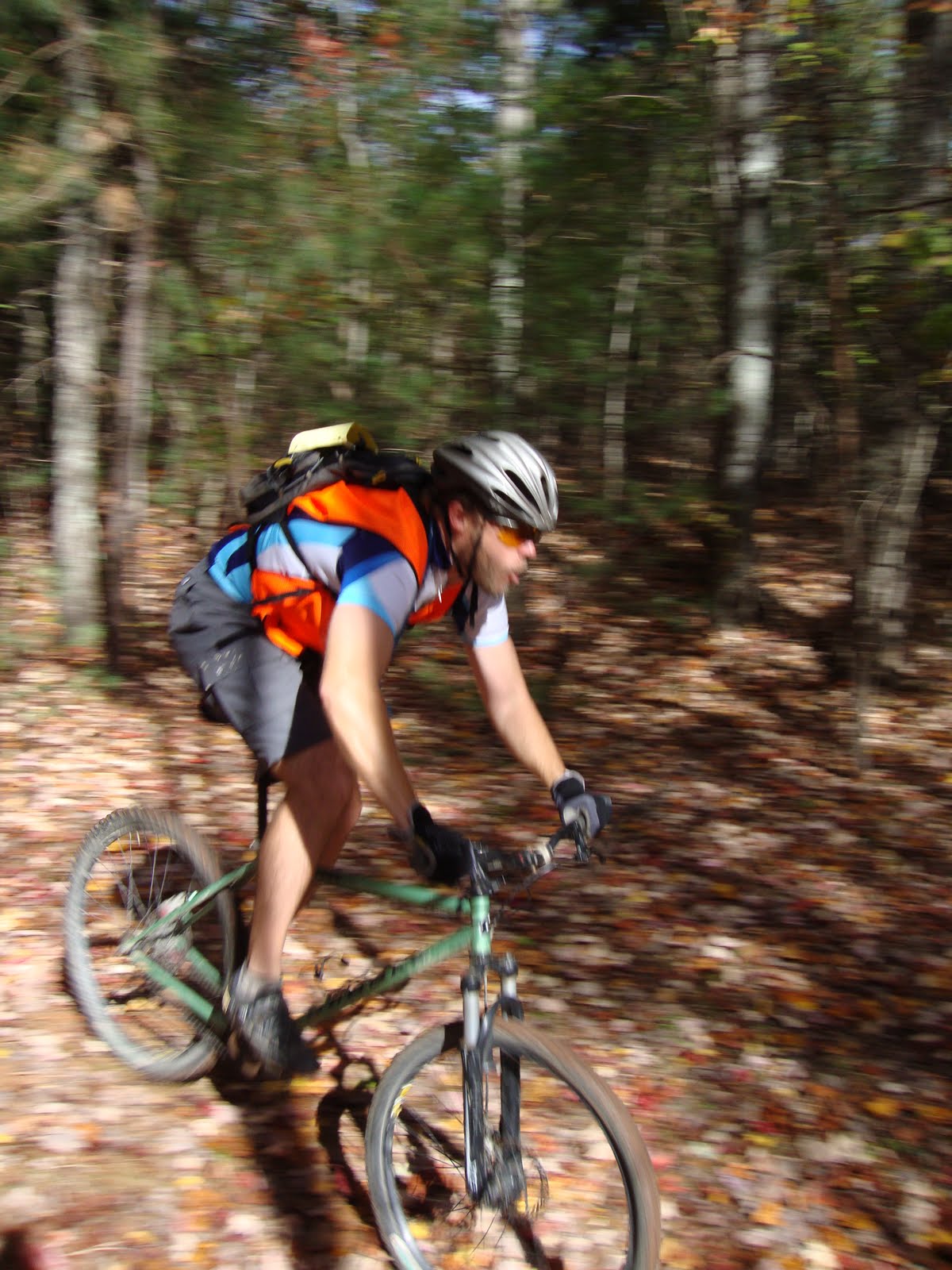
The brisk and sunny morning on Saturday, October 30th provided a perfect setting for a mountain bike race. The riders started the 2.5 mile course at Chapman Pond working their way through the woods to connect with a challenging ascent. After regaining their breath, they descended a fun, newly built single track section then pedaled to the finish. All the riders returned sporting smiles with their bikes (and themselves) intact.
This event came together because of the students here at Ferrum College. Brian Wilson, Matt Fioramonti, Matt Foster, Max Ruozzi and Zack Johnson participated in designing the course layout, trail design and new trail construction. Erin French handled the registration plus timing and Henry Buchanan was out on the course making sure everyone was safe on the day of the race.

Ferrum Outdoors is excited about the growth of mountain bikers on campus and is looking forward to expanding the opportunities and resources for them. New Trails, riding technique and repair clinics, group rides and another race are in the works. Those with bikes or without can contact us at ferrumoutdoors@ferrum.edu or call (540) 365-4324 to take part in activities or receive more information.

Race Results:
1. James Turbyfill
2. Matt Fioramoniti
3. Max Ruozzi
4. Brian Wilson
5. Aaron Conover

Wednesday, October 27, 2010

Folklife Festival 2010 = Success.


If you were at the Blue Ridge Folklife Festival this year you saw a lot. A lot of people. A lot of food. A lot of animals. A lot of community.

The festival was moved this year to be more on the west side of campus -- nearer its host the Blue Ridge Institute and Museum. It made the crowds look a little bigger because people were more clustered -- but initial indications were that the crowd actually was bigger.

Festival coordinator Roddy Moore received estimates from the state police that put the number of people between 10-12 thousand.

Beyond the numbers, many of the food vendors told me they simply ran out of food. Attendees seemed understanding, while those looking to raise money for say, the local church, were tickled to death.

If you've never seen the mule jumping competition, you owe it to yourself to see it at least once -- but beware, you're likely to want a return engagement.

This year's car show was exceptionally strong -- and the antique tractors and crafts were amazing.

If you didn't see the hand carved rattlesnake on the side of a walking stick with each scale carved and painted -- you would think it couldn't be done.

"I wouldn't take less than $500 for it," was the answer when I inquired about the price. If he had said $10,000 it wouldn't have surprised me. Amazing stuff.

Keep an eye on Ferrum.edu for additional information on the Festival. We are working on a short video for our YouTube channel on a Ferrum Alum who designed a turkey call from a piece of slate and a turtle shell. Photos from the event are also available on the front page of the website.

Thanks to all who came.